In the 1920s, the Institute of the Peoples of the North initiated their campaign of developing written norms for the indigenous minorities in the Northern USSR. Erukhim Abramovich Kreinovich, a Soviet ethnographer and linguist, was tasked with the challenge of developing a draft for a Nivkh orthography. He completed his work in 1931, using a subset of the Unified Northern Alphabet.Alkor, 1931. With minor modifications, Kreinovich’ spelling was approved in February of 1932.Alkor, 1934. It was implemented the same year in the primer Cuzd̦if,Krejnovic, 1932. and in a few primary school textbooks,For example the 1936 abecedarium Nivꜧ-bitꜧə (Krejnovic, 1936). and also employed over eleven issues of the short-lived Nivkh newspaper Nivxgu mәkәr-qlaj-d̦if.Kolga et al, 1991/2001.
Shift in language policy
Joseph Stalin’s rise to power in the 1930s signaled a dramatic shift in the Soviet language policy. The Latin orthographies promoted by Institut Narodov Severa were soon replaced by Cyrillic writing, and education in the indigenous languages outlawed.Grenoble, 2006.
In the case of Nivkh, the Latin alphabet was officially replaced in March of 1937Central Executive Committee of the USSR, 1937. and Erukhim Abramovich Kreinovich, who had led its development, was arrested on charges of counterrevolutionary activities and espionage on behalf of Japan. He was sentenced to ten years in Gulag.Memorial Society Krasnoyarsk, n.d. Later in life, Kreinovich would make additional contributions to the studies of Nivkh language.Kreinovich, 1979.
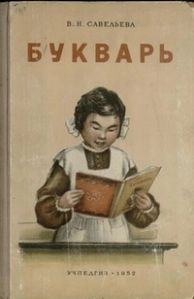
By the time the transition to Cyrillic writing was completed, and a new primer published,Savelyeva, 1952. Nivkh was effectively dead as a written language.Kolga et al, 1991/2001.
Language revival
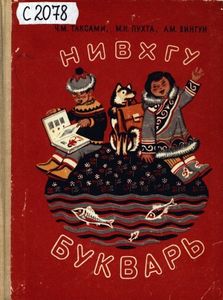
The first inklings of a Nivkh literary revival are the dictionaries of 1965 and 1970: Russian–Nivkh first,Savelyeva & Mikhailovich, 1965. followed by the Nivkh–Russian version.Savelyeva & Mikhailovich, 1970. They were written by Valentina Nikolaevna Savelyeva, author of the 1952 Cyrillic Nivkh primer,Savelyeva, 1952. and Taksami Čhuner Mikhailovich, a Nivkh native ethnographer and linguist. Mikhailovich was the subject of a 2019 exhibition at the National Library of Republic Sakha, showcasing his comprehensive ethnographic and linguistic collections documenting Nivkh culture and language.Ivanov & Valentina, 2019.
The Eesti Keele Instituut lists an alternate Nivkh Cyrillic alphabet from 1968,Eesti Keele Instituut, 2012. sourced from Vladimir Zinov’evich Panfilov’s chapter on the Nivkh language in Mongolskie, tunguso-man'chzhurskie i paleoaziatskie jazyki published that yearPanfilov, 1968. on the basis of his earlier grammatical work.Panfilov, 1962 & 1965.
Contemporary Nivkh
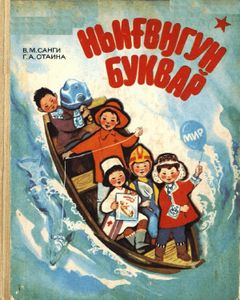
Starting in 1977, the Russian Socialist Republic Ministry of Education initiated the development of new material for primary education in the Nivkh language. A new alphabet was presented on June 29, 1979,Shchetinina, 2013. and primers published in 1981 (Sakhalin island dialect)Sangi & Otaina, 1981. and 1982 (Amur dialect).Mikhailovich et al, 1982. The following years saw a number of Nivkh publications.Shchetinina, 2013.
The implementation of the orthography reveals some variation. The house style of the textbook publishing house Просвещение (“Enlightenment”) uses hooked forms (Ӄ, Ӈ, Ӽ),Anderson, 2022. while the bilingual Nivkh-Russian newspaper Нивх диф (“Nivkh Dif”) – published in monthly editions since 1990 – prefers straight descenders (Қ, Ң, Ҳ).Mygun, 2025.
Literature
Alkor, Y. P. (Ed.). (1931). Письменность народов Севера: Книга Х [Culture and Writing of the East: Book X], pp. 12–31. All-Union Central Committee of the New Alphabet. Retrieved 20 September 2026 from viewer.rsl.ru
Alkor, Y. P. (Ed.). (1934). Языки и письменность народов Севера, vol 3 [Languages and writing of the peoples of the North, vol 3], pp. 184–187. Institut Narodov Severa. Retrieved 20 September 2026 from prlib.ru
Anderson, D. (2022, December 29). UTC and Script Ad Hoc: Comments on CYRILLIC CHE WITH HOOK’s use in Khanty and Tofa (Tofalar) (L2/22-280). Unicode Consortium. Retrieved 20 September 2026 from unicode.org
Bledsoe, B. (n.d.). The Significance of the Bear Ritual Among the Sami and Other Northern Cultures. Retrieved 20 September 2026 from web.archive.org
Central Executive Committee of the USSR. (1937, March 7). Новые алфавиты для народов Севера [New alphabets for the peoples of the North]. In Остяко-Вогульская правда [Ostyako-Vogulskaya Pravda] 73(729), p. 3. Retrieved 20 September 2026 from web.archive.org
Eesti Keele Instituut. (2012). Nivhi: Nivkh: Нивх (Ниғвӈ) Nivh (Niǧvŋ). Retrieved 20 September 2026 from arhiiv.eki.ee
Grenoble, L. A. (2006). Language Policy in the Soviet Union, p. 54. Springer Science & Business Media. Retrieved 20 September 2026 from books.google.no
Ivanov, A. & Valentina, N. (2019). The World of the Nivkhi. National Library of Republic Sakha. Retrieved 20 September 2026 from old.nlrs.ru
Kolga, M., Tõnurist, I., Vaba, L. & Viikberg, J. (2001). The Nivkhs. In The Red Book of the Peoples of the Russian Empire. (Original work published 1991). Retrieved 20 September 2026 from arhiiv.eki.ee
Kreinovich, E. A. (1932). Cuzd̦if [New Word]. Institut Narodov Severa.
Krejnovic, E. A. (1936). Nivꜧ-bitꜧə [Nivkh Abecedarium]. Uꞓpedgiz.
Kreinovich E. A. (1979). Нивхский язык [Nivkh language]. In Языки Азии и Африки [Languages of Asia and Africa]. Vol. 3, pp 295–329. Moscow. Retrieved 20 September 2026 from knigaplus.ru
Memorial Society Krasnoyarsk. (n.d.). Крейнович Ерухим Абрамович [Kreinovich Erukhim Abramovich]. Retrieved 20 September 2026 from memorial.krsk.ru
Mikhailovich, T. Č., Nikolaevna, P. M. & Mikhailovna, V. A. (1982). Букварь: для подготовительного класса нивхских школ: амурский диалект [ABC Book: for the Preparatory Class of Nivkh Schools: Amur Dialect]. Prosveshchenie. Retrieved 20 September 2026 from e.nlrs.ru
Mygun, F. S. (Ed.). (2025). Нивх диф [Nivkh Dif] 1(359). Sakhalin Oblast. Retrieved 20 September 2026 from morningislands.ru
Nivxgu mәkәr-qlaj-d̦if [The Nivkh truth]. (1930). Nikolayevsk-on-Amur.
Panfilov, V.Z. (1962). Грамматика нивхского языка. Grammatika nivxskogo jazyka [A Grammar of the Nivkh Language], vol. 1. Nauka.
Panfilov, V. Z. (1965). Грамматика нивхского языка. Grammatika nivxskogo jazyka [A Grammar of the Nivkh Language], vol 2. Nauka.
Panfilov, V. Z. (1968). Nivxskij jazyk [Nivkh language]. In V. V. Vinogradov (Ed.), Mongolskie, tunguso-man'chzhurskie i paleoaziatskie jazyki, pp. 408–434. Nauka.
Protodyakonov, P. (1884). Гольдскую азбуку для обучения гольдских и гилякских детей [The Goldi alphabet for teaching Goldi and Gilyak children]. Orthodox Missionary Society. Retrieved 20 September 2026 from vivaldi.nlr.ru
Rosstat. (2020). Всероссийская перепись населения 2020 [All-Russian Population Census 2020]. Federal State Statistics Service. Retrieved 20 September 2026 from web.archive.org
Sangi, V. & Otaina, G. (1981). Ньиғвӈгун буквар̌ [Nyigovgun alphabet book]. Ministry of Education of the RSFSR. Retrieved 20 September 2026 from twirpx.com
Savelyeva, V. N. (1952). Букварь: Для подготовит. кл [ABC book: For preparatory classes]. Uꞓpedgiz. Retrieved 20 September 2026 from rusneb.ru
Savelyeva, V. N. & Mikhailovich, T. Č. (1965). Russkij–nivxsko Slovar' [Russian–Nivkh dictionary]. Sovyetskaya Èntsiklopedia.
Savelyeva, V. N. & Mikhailovich, T. Č. (1970). Nivxsko-russkij Slovar' [Nivkh–Russian dictionary]. Sovyetskaya Èntsiklopedia.
Shchetinina G.S. (2013). Развитие письменности малочисленных народов Севера. Обучение детей-нивхов родному языку [Development of the Writing System of the Indigenous Peoples of the North: Teaching Nivkh Children Their Native Language].